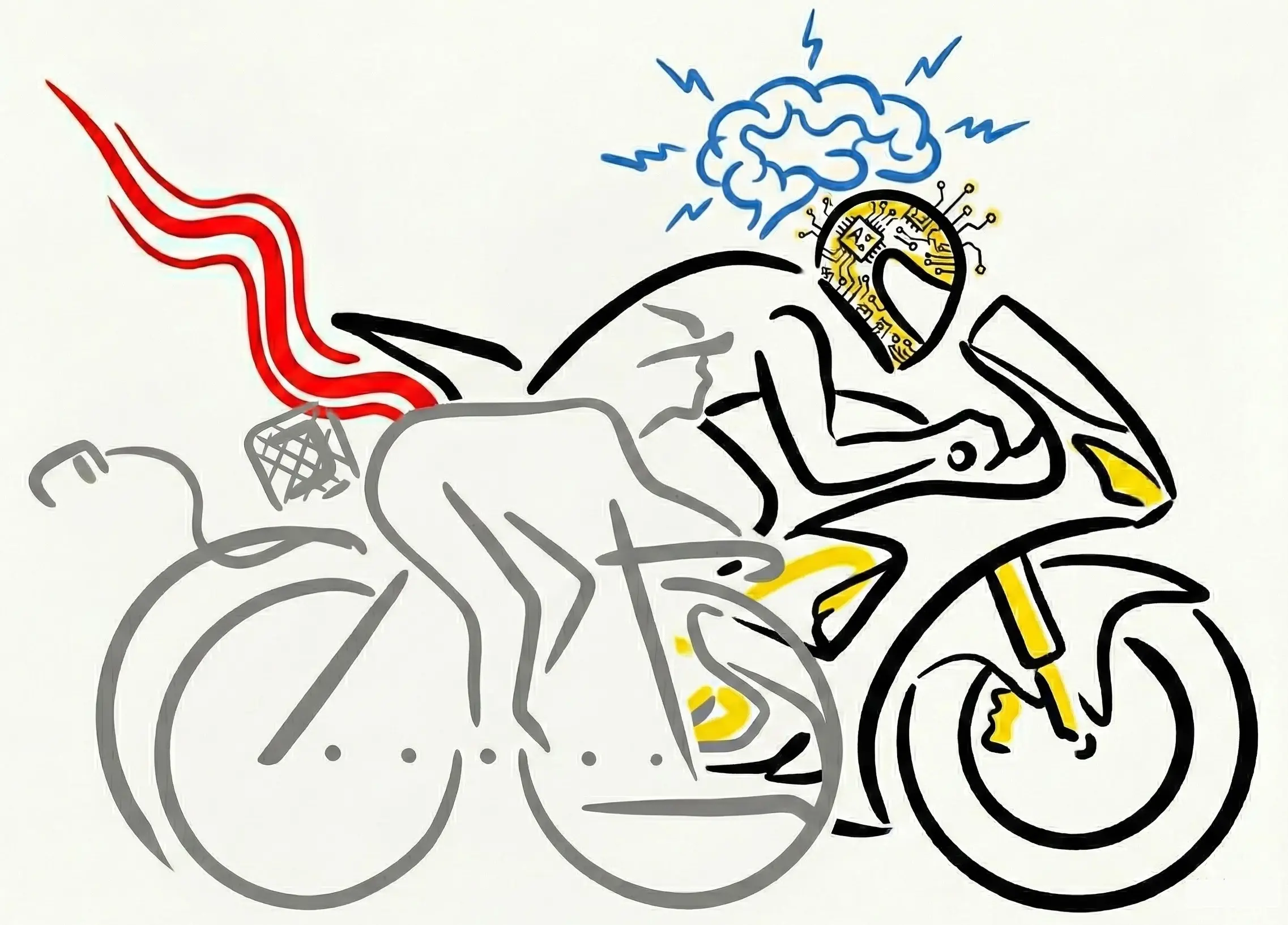
Steve Jobs famously called the computer a bicycle for the mind.
We humans are tool builders… We can fashion tools that amplify these inherent abilities to spectacular magnitudes. So for me, a computer has always been the bicycle of the mind. Something that takes us far beyond our inherent abilities.
That sentiment feels prescient again today but the vehicle has changed.
If the personal computer was a bicycle, AI is a motorbike for the mind.
I choose this distinction carefully.
To ride a bicycle well, you must build muscle. The motorbike is different. You cover vast distances without any tax on your body. Ride it long enough, and the muscles you once relied on atrophy. It’s seductive to ship words or code while skipping the slow, painful work. But wrestling with edge cases is how you learn what “good” looks like: a skill you’ll need to sharpen even more with AI doing the typing.
Speed also changes the nature of failure. A fall at 10 mph is a bruise: a bug you can trace and learn from. A fall at 60 mph is fatal: a bug hidden in code you never wrote, its damage everywhere before you notice. Keep vibe-coding your entire system1 without understanding every line, every trade-off; you’ll eventually crash.
Here’s the thing about motorbikes: everyone can twist the throttle. What separates riders who arrive from those who crash is knowing when to brake – when to stop, look, and understand before you ship. In an age where anyone can go fast, the true skill is no longer the throttle. It’s the brake.